Even My Guitar didn't believe me
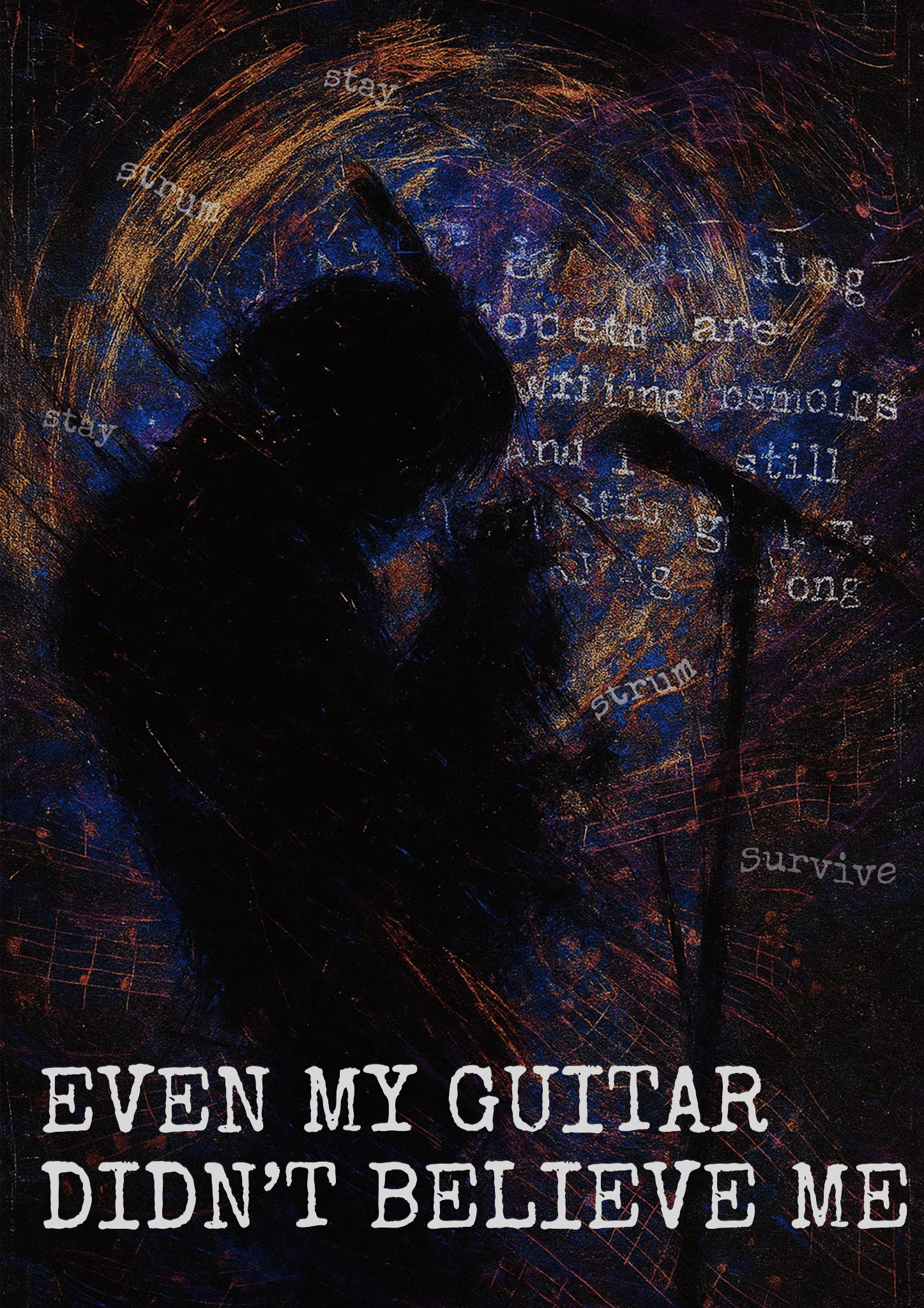
At 3:17 a.m., when the streetlights outside shivered like dying fireflies, Darpan pressed play on “A Different Age.” The room was small enough that the music felt like breath against his neck. His guitar stood slumped in the corner, strings slightly rusted, accusation written across its broken tuning. The unfinished poem on his desk looked like a failed attempt at meaning - a sentence cut in half, abandoned mid‑thought. The bulb above him flickered unevenly, casting shadows that trembled across the walls like they were trying to climb out of the room.
Nick Rattigan’s voice arrived softly, almost apologetically, and the line floated in: “Oh, all the poets are writing memoirs but I’m still singing this song…” It didn’t stab him. It entered with the intimacy of grief that knows where you hide your weaknesses. Darpan closed his eyes. His breath wavered. The night began to contract around him, the air thickening with every syllable in the song. He listened, motionless, as the voice and the darkness folded into each other.
Memories rose with the same force as sudden cold water. He remembered his mother humming while washing dishes, the monsoon wind rattling the windows, the hiss of old cassettes turning inside a cheap tape recorder. At six, he had played Mohiner Ghoraguli until the tape thinned and warped, until the songs sounded like they were singing from the bottom of a well.
Back then, music was safety. By fourteen, it became escape. In school, equations made his throat tighten; guitars loosened it. He failed 11th grade spectacularly - the infamous 3 out of 100 in maths stamped at the top of his paper like a cosmic joke. His teachers shook their heads. His father stayed silent. His mother folded his shame into her silence.
At eighteen, he left home without a goodbye long enough to mean anything. Darjeeling held him kindly for a while; Shillong swallowed him whole. Nights blurred into one another dim bars, cracked amplifiers, sticky floors, chords played to people too drunk to hear him. The music kept him alive. Everything else pulled him under.
His companions began dying one by one, overdoses, accidents that weren’t really accidents. Bodies found too late in rooms that smelled of smoke and wasted youth. The first call shattered him. The second hardened him. The third almost ended him. He stopped attending funerals. Grief drained from a wound he no longer had the strength to close.
There was a night - Shillong, rain thick as guilt - when he stood on a rooftop, shoes at the edge, phone buzzing with another message: another friend gone. The city below glowed faintly, uncaring. He leaned forward a fraction, enough to feel the pull of gravity on his bones. It would have been quiet. Simple. Over. But the rain kept slapping his face, loud and insistent, as if the world refused to let him vanish unnoticed. He stepped back, not out of hope but out of exhaustion.
The next morning, he sat by Pollock Lake, clothes stiff with dried rain, eyes swollen, body cold. The water mirrored the sky like a wound pretending to heal. He watched the surface tremble with small breaths of wind and realized he wasn’t ready to disappear. Not like his friends. Not yet.
He returned home. He cleaned up. He stayed clean. 2017 became a line he never let himself cross again. But sobriety wasn’t salvation. It was another kind of loneliness quieter, sharper, harder to negotiate with. The world kept moving forward; he felt stuck in a season that refused to end.
Now, years later, this song in his headphones was dragging every buried ghost back into the room, along with something newer - that strange ache sobriety left behind. Sobriety gave him strength, yes but it also left behind a silence he never prepared for.
He overcame one demon, but at the cost of years he cannot reclaim. Sometimes he still lies awake staring at the ceiling, paralyzed by the fear that the magic is gone. Music doesn’t flow naturally to him anymore; he often misses the notes that he used to own.
The track built slowly, painfully, until Nick’s voice reached that breaking point - a trembling scream like someone clawing out of their own chest. “But this song is a joke, and the melody I wrote wrong…” As the line echoed, the bulb flickered again, darker this time, and shadows crawled like something waking.
Darpan’s throat tightened helplessly. His heartbeat stumbled. He reached for the guitar, hands trembling, fingers hovering as if the strings were made of fire. He strummed once, wrong. He tried again. Worse. He pressed harder; Wrong, wrong, wrong. Frustration surged like blood. He wanted to smash the guitar on the desk and break the silence.
The scream in the song grew unbearably loud, filling the room like smoke. Darpan pressed both hands against his face, shoulders shaking, breath breaking in uneven bursts. His eyes wandered helplessly and landed on the small razor blade lying on the desk leftover from trimming loose guitar strings. Thin, silver, perfectly still. Waiting. For a moment, the world held its breath. He reached out. His fingers brushed the cold metal. His vision blurred. His pulse thrummed with a terrifying clarity.
Then he saw the notebook, half buried, open to a line he didn’t remember writing. Unfinished, unpolished, but alive. The razor slipped from his fingers, clattering against wood- a small sound, but enough to break the air. His hand moved instead to the pen and then the guitar.
He wrote one word. It stayed. Another. His chest loosened just enough to breathe. Dawn pressed at the window. Nothing was fixed - but nothing was lost.
He strummed again and again but all in vain. He kept on playing. Not to sound beautiful, but to refuse silence. Because maybe music isn’t magic. Maybe it just effort - stubborn, trembling effort. And effort is how something broken learns to live.
The sun finally entered the room - pale, slow, forgiving. His melody was uneven, his rhythm flawed, but his hands did not stop. He kept playing, failing, and beginning again. Because that’s how the magic returns - one note at a time. And starting again - fragile, stubborn, relentless - is how a human survives.